
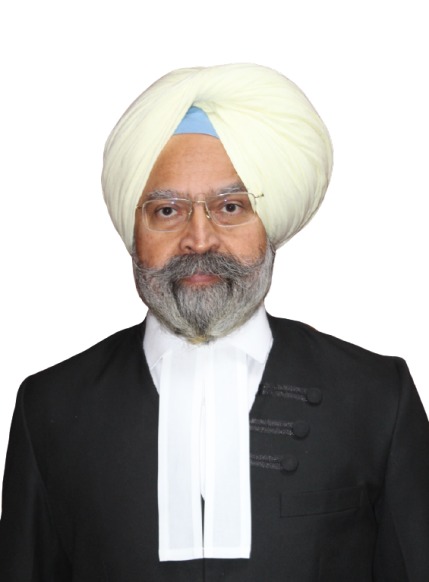
Hon'ble Mr. Justice Anupinder Singh Grewal is presently serving as the President of the National Company Law Tribunal. He retired as a Judge of the Punjab and Haryana High Court on 9 March 2026 after a distinguished judicial career spanning more than three decades in the legal profession, including more than eleven years on the Bench.
Justice Grewal received his schooling from St. John's High School, Chandigarh, and completed his ISC from Yadavindra Public School, Patiala. He pursued his graduation and post-graduation in History from St. Stephen's College, Delhi, before obtaining his LL.B. degree from the University of Delhi.
Justice Grewal commenced practice before the Punjab and Haryana High Court in 1992. He worked in the Office of Advocate General of Punjab for 19 years, including nine years as an Additional Advocate General. He represented the State in several important cases in a wide range of subjects. During his tenure as a Law Officer, he represented the State in diverse matters involving constitutional law, civil and criminal law, service jurisprudence, land acquisition, and public interest litigation. He also served as Central Government Counsel and as Senior Panel Counsel for the Union of India.
He was elevated as an Additional Judge of the Punjab and Haryana High Court on 25 September 2014. Upon his transfer to the Rajasthan High Court, he was sworn in as a Permanent Judge on 20 May 2016 and was transferred back to the Punjab and Haryana High Court on 5 October 2016, where he continued to serve until attaining the age of superannuation.
Apart from his judicial work, Justice Grewal discharged several important administrative responsibilities. He served as Chairman of various Committees of the Punjab and Haryana High Court, including the Vigilance and Disciplinary Committee. He was also entrusted with the selection process for appointment of the Chairperson and Members of the Real Estate Regulatory Authority as the nominee of the Chief Justice. He functioned as Administrative Judge of several key districts, including Gurugram and Amritsar.
His contributions to the development of law are reflected across diverse fields of jurisprudence. In Kiran v. Chandigarh Housing Board, his Bench held that welfare and rehabilitation schemes should be interpreted liberally so as to advance their beneficial object and protect underprivileged citizens, including by recognising the constitutional dimension of the right to affordable housing.
In Simone Verma & Anr. v. State of Punjab & Ors., his Bench, while exercising jurisdiction under Article 226, adopted a purposive approach to secure relief for orphaned children, including financial relief and educational support, by requiring the concerned non-banking financial company to waive the outstanding housing loan and provide for their education under its CSR Scheme.
In Surekha v. Axis Bank, his Bench addressed a legislative vacuum concerning the protection of incapacitated persons and laid down guidelines for the states of Punjab and Haryana and the Union Territory of Chandigarh relating to their guardianship and care.
His Bench also exercised suo motu jurisdiction under Article 226 to quash more than 1,100 criminal cases arising from COVID-19 violations in the states of Punjab and Haryana and the Union Territory of Chandigarh, thereby underscoring the scope of constitutional writ jurisdiction in safeguarding individual rights against the disproportionate continuation of proceedings.
Justice Grewal also rendered important decisions concerning child welfare and family law, particularly in matters arising from international child custody disputes. His decisions emphasised that the welfare and best interests of the child must remain the paramount consideration in determining questions of custody. In another case, while granting custody of a minor child to the mother, he held that allegations of an extramarital relationship, even if assumed to be true, could not by themselves establish that the mother was incapable of being a good parent or of looking after the welfare of the child.
In Master Eric Thind v. UOI, he recognised the parental rights of a single biological father and declared him the sole guardian of his surrogate child. The case arose after the Australian Embassy rejected the visa application of the child on the ground that the applicable laws relating to surrogacy for single parents were unclear. In addressing the issue, he recognised the parental rights of the biological father and affirmed his status as the sole guardian of the child. In V.K. Janjua v. State of Punjab, he directed the State Government to forward to the Central Government the documents pertaining to the grant of sanction to prosecute a former Chief Secretary, addressing the legal and procedural requirements governing such prosecution.
His judgments in matters such as Surjit Singh v. State of Punjab and Manjit Singh @ Manga v. State of Punjab underscored the importance of personal liberty, fairness in criminal investigations, and accountability of law enforcement agencies. These decisions reflected a consistent emphasis on safeguarding constitutional rights while ensuring adherence to the rule of law.
Among the notable matters considered by his Bench was Gurdeep Singh Gill v. State of Punjab, concerning the Punjab Land Pooling Policy, 2025, affecting 65,000 acres of prime urban land. The Bench emphasised the importance of compliance with constitutional and statutory safeguards, including transparency and impact assessment, and stayed the implementation of the policy on prima facie grounds. The proceedings ultimately culminated in the withdrawal of the policy by the State Government. Justice Grewal also presided over and monitored several important public interest and suo motu proceedings relating to prison administration, gangster culture, police accountability, governance issues, and criminal justice reforms. These matters reflected his continuing engagement with systemic concerns affecting the administration of justice and the protection of fundamental rights.
As a keen sportsman, he represented Punjab in the Cooch Behar Cricket Trophy conducted by the BCCI from 1978 to 1982. He also distinguished himself in golf and recorded the best round in the All-India Juris Cup Golf Tournament for Lawyers and Judges on several occasions. He represented the Chandigarh golf team in an All-India tournament in Chennai in 1993. He stood second in the amateur section of the Northern India Golf Tournament in 1993. He won a bronze medal in the Chandigarh State Games in 2005 and recorded the best round in several golf tournaments, including AWS Golf in Jamshedpur in 2022. He won the top amateur slot and qualified for the PGTI tournament in Chandigarh in 2022.